
When specifying veneer doors for your next project—whether for a pocket door system, internal sliding doors, or any interior sliding doors—it’s important to understand how veneer construction influences appearance, performance, and cost. Veneer doors offer beautiful natural grain variation and a premium finish, but their manufacturing constraints can impact the final design. Getting these details right at the planning stage prevents surprises on site and ensures your doors look exactly as intended.
Understanding Veneer Sheet Sizes
Timber veneers are typically supplied in set sheet sizes and are usually around 0.6 mm thick, pressed over a stable substrate such as MDF or similar core material. When your project requires oversized door heights or widths—common in luxury residential and commercial spaces—these sheet size limitations come into play.
For oversized widths, you may see a vertical join line where two veneer leaves meet. This is completely normal, but it’s worth planning for so the location of the join aligns with the design intent. Oversized heights can be handled in a more visually integrated way: introducing horizontal feature V-grooves helps break the transition between veneer sheets naturally. These grooves can become a purposeful architectural feature rather than a workaround.
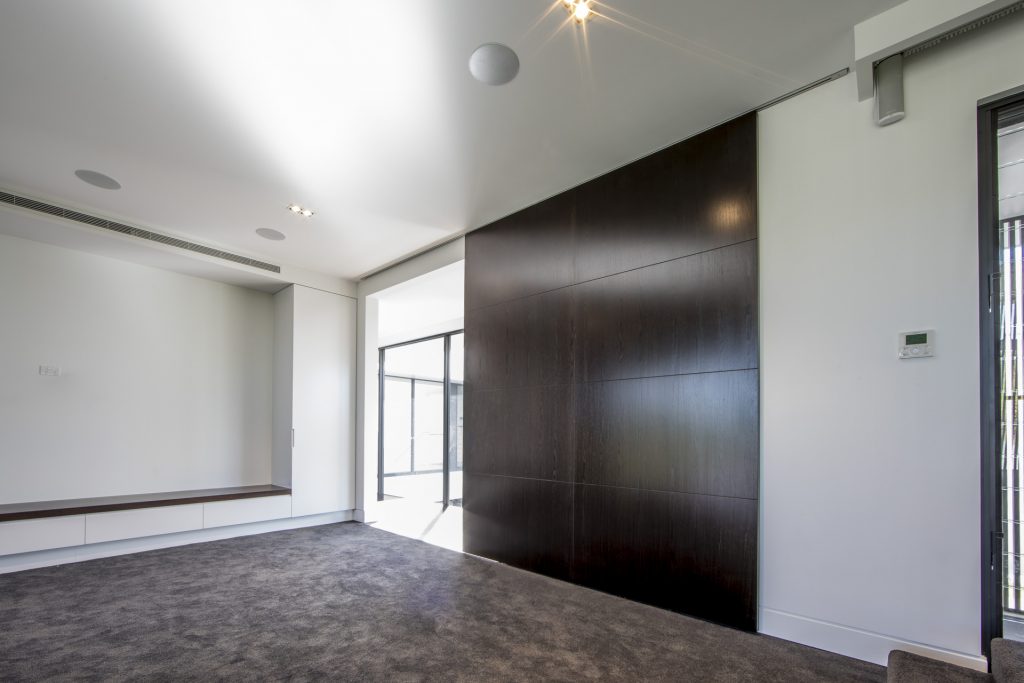
If your design includes V-grooves of any kind, keep in mind that the veneer layer is very thin. Because of this, grooves often expose the substrate, so these areas may require colour-matched paint, stain, or—if you prefer a fully consistent look—veneer laid inside the groove. Make sure this requirement is specified clearly when ordering.
Door Edge Treatments
Another key decision is how the door edges will be finished. Two main options are available:
- Solid timber edge strips that match the veneer species
- Built-up veneer layers that wrap the edge for a continuous, seamless look

Solid edges tend to be more durable and are ideal for high-traffic applications. Built-up veneer, on the other hand, is perfect when a premium, uninterrupted appearance is the priority, helping the veneer visually “wrap around” the door leaf.
Choosing the right method early ensures the door integrates beautifully into your timber sliding door or pocket door system without visible inconsistencies.
Veneer Cuts: Crown-Cut vs Quarter-Cut vs Rotary Cut
The way veneer slices are cut dramatically impacts the grain aesthetics of interior sliding doors and custom door designs.
Quarter-Cut
Quarter-cut veneers are sliced along the radius of the log, resulting in straight, linear grain patterns. This is a favourite for commercial spaces, minimalist themes, or any project wanting a refined, consistent aesthetic.
Crown-Cut
Crown-cut veneers are sliced across the log, creating a sweeping, cathedral-shaped grain. This produces warm, organic patterns and is popular for residential environments or designs seeking a feature timber moment.
Rotary Cut
Rotary cut veneer is produced by mounting a log in a lathe and peeling it in a continuous sheet, much like unrolling paper towel. This method creates broad, highly varied grain patterns and maximises yield, making it a cost-effective option for painted doors, large surface areas, or applications where a consistent architectural grain match is not the primary design focus.

Neither cutting style affects the structural performance of the door—the decision is purely visual.
Veneer Matching Techniques
Once veneers are cut, the next stage is matching the leaves. This influences how the timber grain flows across the panel and ensures consistency across large door faces or multiple doors in a series. The following matching options are commonly used in architectural and bespoke joinery:
Book Matching
Each veneer leaf mirrors the next, like opening the pages of a book. The result is a symmetrical, centre-focused pattern that highlights natural grain movement beautifully.

Slip Matching
Leaves are placed face-up, side-by-side. The grain repeats across the face without mirroring, giving a clean, uniform look—great for contemporary interiors.

Reverse Slip Matching
Every second leaf is flipped end-to-end to balance grain patterns, which is particularly useful for evening out the points or “crowns” of the grain across the height of a tall door. It softens the marching or stacked look of a standard slip match, creating a more relaxed and natural rhythm.

Random Matching
Often called mismatched, this technique places leaves in random orientation to achieve a rustic, board-by-board appearance. Perfect for designs wanting character and irregularity.
Quarter Matching
Four book-matched pieces are mirrored both horizontally and vertically, forming a central focal point. This is ideal for large feature doors or panelled walls.
Joining & Specialty Matching
More advanced methods—such as end-matching, radial patterns, herringbone, V-matches, or sunbursts—use the natural grain direction to create striking visual effects. These require specialist skill and are typically used for high-end architectural statements.
Final Thoughts
When specifying veneer doors for internal sliding doors or a premium pocket door system, planning ahead is everything. Oversized panels, edge treatments, veneer cuts and matching styles all influence the final aesthetic—and each requires clear documentation to achieve the exact look you’re after.
By understanding these considerations early, you’ll ensure your veneer doors arrive perfectly aligned with your design intent, ready to elevate the entire space.
